So, the most common google search used to find this blog is about wedge fractures in the vertebrae. I thought I'd send everyone on to much better resources than I could possibly provide.
Obviously, you can find these links via google, but this blog seems to be bumping some of them off the top page (and will probably bump some more after I post this)...
Links follow:
University of Maryland explanation on the causes and treatments of compression fractures.
American Family Physician journal article about compression fractures in people with osteoporosis.
SpineUniverse discussion by a professor from the University of Wisconsin, re: treatment.
Another article at the same website by the same professor.
And yet another (of course, you could just follow the links at the bottom of the articles).
American Journal of Roentgenology paper on diagnosing vertebral fractures.
X-rays of vertebral fractures from the above paper.
Discussion of vertebroplasty, a method of treating a wedge fracture by injecting bone cement into the affected vertebra.
Another article about injecting bone cement into a fractured vertebra, in the journal Spine. This article shows mixed results w.r.t. recovered behavior of the bones.
Article on how to deal with osteoporosis, including exercises that should help.
A few paragraphs about wedge fractures.
Google Books preview of a book called Practical Fracture Treatment.
Paragliders are likely to break their backs, apparently...
Google Books preview of The Osteoporosis Book.
Another discussion of vertebroplasty and kyphoplasty.
Google Books preview of Tidy's Physiotherapy, a book for students of...physiotherapy.
American Journal of Neuroradiology article on kyphosis correction and vertebroplasty.
Article from Rice University about testing spinal stability.
Anyway, obviously I cannot reproduce the google results pages.
Here are some of the search terms I used.
wedge fracture vertebrae recovery T6 osteoporosis vertebroplasy kyphosis kyphoplasty treatment
Good luck on your recovery!
Monday, March 9, 2009

Saturday, March 7, 2009
Pluto: A planet? a plutoid? a minor planet? a dwarf planet?
So, DS occasionally corrects his books on planets that were written before the latest IAU renaming event. That's fine. It's good for him to think about how science happens and why we need to sometimes reclassify things when new information comes to light.
Here's the basic history of the naming of the planets:
1) Etymology of the word planet:
late O.E., from O.Fr. planete (Fr. planète), from L.L. planeta, from Gk. (asteres) planetai "wandering (stars)," from planasthai "to wander," of unknown origin. So called because they have apparent motion, unlike the "fixed" stars. Originally including also the moon and sun; modern scientific sense of "world that orbits a star" is from 1640.
2) That "modern scientific sense" is not quite accurate any more. Here are some reasons:
A) Ganymede, one of Jupiter's moons is larger in radius than Mercury by about 200 km.
B) Pluto's orbit is very strange compared with the eight other planets; Pluto sometimes is closer to the sun than Neptune. No, they're not likely ever to hit each other.
C) There are objects outside of Pluto's orbit that are larger than Pluto; should they be called planets? If so, we're going to end up with a few hundred or more planets in our solar system; we'll never come up with a reasonable mnemonic to remember their names. ;)
Here's the resolution by the IAU, the body responsible for naming objects in space:
So, this is really just taxonomy.
Here's the deal. Nearly every planetary scientist I know refers, in casual conversation, to the larger objects they study as planets: Ganymede is a planet, Io is a planet, Mars is a planet, Pluto is a planet. This isn't out of some kind of misguided rebellion, it's just easier. When we write technical manuscripts, we use the correct taxonomy when necessary. This is because we like to have a reliable and predictable method of categorizing things.
So, some people feel bad for Pluto and think it should be re-instated as a planet. Who cares? It was still the ninth large object discovered orbiting our sun (as opposed to orbiting an object orbiting our sun). Some people have taken it pretty far.
Here's how far it's gone:
The Illinois State Senate has:
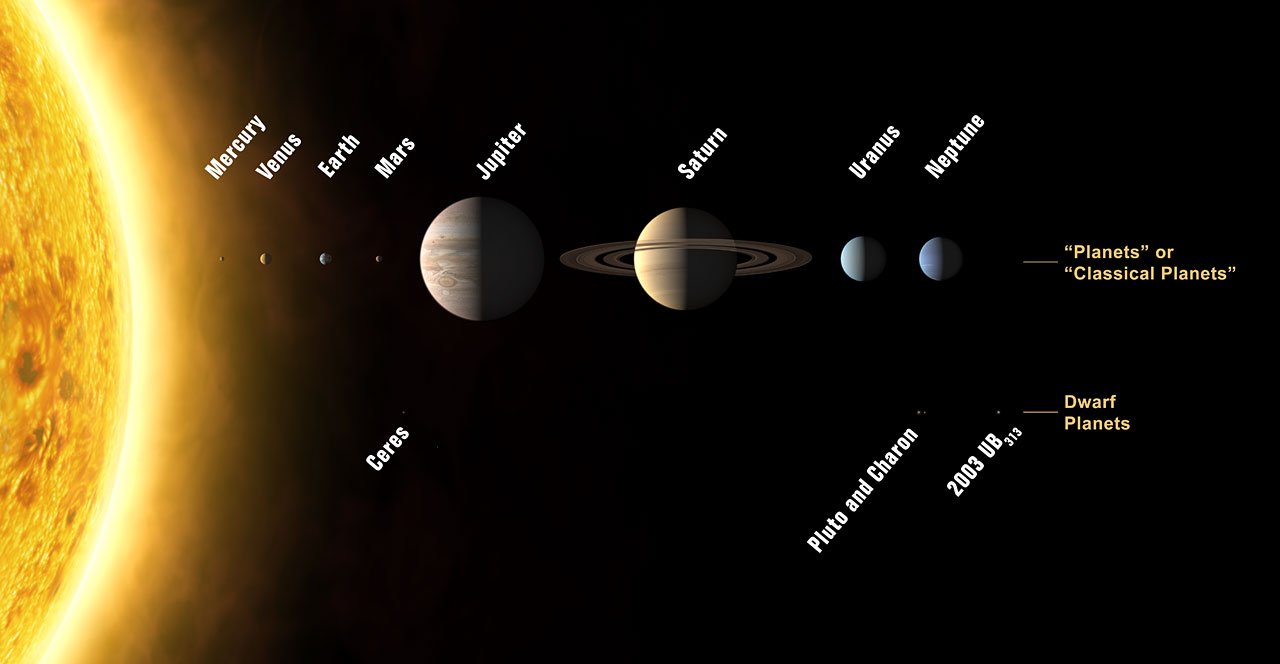
Here's a graphic that shows the current taxonomy of our solar system's objects:

Here's the basic history of the naming of the planets:
1) Etymology of the word planet:
late O.E., from O.Fr. planete (Fr. planète), from L.L. planeta, from Gk. (asteres) planetai "wandering (stars)," from planasthai "to wander," of unknown origin. So called because they have apparent motion, unlike the "fixed" stars. Originally including also the moon and sun; modern scientific sense of "world that orbits a star" is from 1640.
2) That "modern scientific sense" is not quite accurate any more. Here are some reasons:
A) Ganymede, one of Jupiter's moons is larger in radius than Mercury by about 200 km.
B) Pluto's orbit is very strange compared with the eight other planets; Pluto sometimes is closer to the sun than Neptune. No, they're not likely ever to hit each other.
C) There are objects outside of Pluto's orbit that are larger than Pluto; should they be called planets? If so, we're going to end up with a few hundred or more planets in our solar system; we'll never come up with a reasonable mnemonic to remember their names. ;)
Here's the resolution by the IAU, the body responsible for naming objects in space:
RESOLUTIONSResolution 5A is the principal definition for the IAU usage of "planet" and related terms.
Resolution 6A creates for IAU usage a new class of objects, for which Pluto is the prototype. The IAU will set up a process to name these objects.
IAU Resolution: Definition of a "Planet" in the Solar System
Contemporary observations are changing our understanding of planetary systems, and it is important that our nomenclature for objects reflect our current understanding. This applies, in particular, to the designation "planets". The word "planet" originally described "wanderers" that were known only as moving lights in the sky. Recent discoveries lead us to create a new definition, which we can make using currently available scientific information.
RESOLUTION 5A
The IAU therefore resolves that planets and other bodies in our Solar System, except satellites, be defined into three distinct categories in the following way:
(1) A "planet" [1] is a celestial body that (a) is in orbit around the Sun, (b) has sufficient mass for its self-gravity to overcome rigid body forces so that it assumes a hydrostatic equilibrium (nearly round) shape, and (c) has cleared the neighbourhood around its orbit.
(2) A "dwarf planet" is a celestial body that (a) is in orbit around the Sun, (b) has sufficient mass for its self-gravity to overcome rigid body forces so that it assumes a hydrostatic equilibrium (nearly round) shape [2], (c) has not cleared the neighbourhood around its orbit, and
(d) is not a satellite.
(3) All other objects [3], except satellites, orbiting the Sun shall be referred to collectively as "Small Solar-System Bodies".
IAU Resolution: Pluto
RESOLUTION 6A
The IAU further resolves:
Pluto is a "dwarf planet" by the above definition and is recognized as the prototype of a new category of trans-Neptunian objects.
So, this is really just taxonomy.
Here's the deal. Nearly every planetary scientist I know refers, in casual conversation, to the larger objects they study as planets: Ganymede is a planet, Io is a planet, Mars is a planet, Pluto is a planet. This isn't out of some kind of misguided rebellion, it's just easier. When we write technical manuscripts, we use the correct taxonomy when necessary. This is because we like to have a reliable and predictable method of categorizing things.
So, some people feel bad for Pluto and think it should be re-instated as a planet.
Here's how far it's gone:
The Illinois State Senate has:
RESOLVED, BY THE SENATE OF THE NINETY-SIXTH GENERALHmm... More legislative meddling in the affairs of science a la the Indiana attempt in 1897 to legislate the value of Pi? I'm not sure. This is not exactly a bill requiring that Pluto be called a planet; it's a resolution stating that the Illinois senate would like to make March 13 "Pluto Day" in the state of Illinois (and also that they would like to see Pluto reinstated as a planet, but it's not like they can do anything about that). This is certainly not binding; the science books in Illinois are not necessarily going to be any different from those in the rest of the US because of this resolution. Also, during the same legislative session, the Illinois Senate encouraged the state citizens to recognize that age 50 is a great and wondorous mark of wisdom (I'm not saying it isn't!).
ASSEMBLY OF THE STATE OF ILLINOIS, that as Pluto passes
overhead through Illinois' night skies, that it be
reestablished with full planetary status, and that March 13,
2009 be declared "Pluto Day" in the State of Illinois in honor
of the date its discovery was announced in 1930.
Here's a graphic that shows the current taxonomy of our solar system's objects:
Sunday, March 1, 2009
Magnetism: What is attracted to a magnet?
My son's school is having its science fair this week (okay, two weeks ago now; I'm late). My son is in kindergarten. His teacher made participation in the fair a required activity (have I mentioned how much I like her?).
So, DS wanted to play with magnets for his project.
His question: What sticks to a magnet.
His methodology: Get a bunch of different kinds of things and test whether they stick to a magnet by trying to pick them up with a magnet. He tested plastic objects, metal objects, coins, paper, and some other things. If an object responded at all to the pull of the magnet, he considered it to have stuck.
His results: Metal sticks to a magnet. However, not all metals do; coins, for example, do not stick to magnets. No non-metal objects stuck to the magnet.
He asked how do magnets work. His mom answered, "magic." Seriously. She thinks magnets are magical. /sigh Two steps forward, 1.5 steps back. Okay, maybe she doesn't seriously think that, but come on...
So. How do magnets work?
Actually, it's a little difficult, so my DW has a good excuse for explaining it away with magic.
Before I go any further, I need to confess that I slept through most of my magnetohydrodynamics class in graduate school; I only earned a B. The fundamentals of magnetism is a difficult subject for me so most of what I tell you is just scratching the surface and may not be entirely accurate.
First, a magnetic field is essentially an area of influence caused by an electric current. An electric current can travel through wires, such as your computer, or microscopically when individual electrons move in their orbit around an atom's nucleus. Now, it's not just the flow of electrons that creates a magnetic field. Electrons "spin" in a particular direction. In normal materials, the electron spin is pretty much randomly distributed, but in a magnet, the spin is aligned such that the flowing electrons all have the same spin.
This flow of spin-aligned electrons causes magnet(ic field)s to be dipolar. That is, a magnet has a "north" and a "south" pole. (dipolar, not bipolar; magnets are not manic-depressive.). By convention, electrons flow from the north pole to the south pole. You can see this by putting a bar magnet under a piece of paper with a bunch of iron fileings on the top; they'll align along the field lines.
When spin-aligned electrons encounter other spin-aligned electrons going in the opposite direction, they're repelled from each other. Thus when you put the north (or south) poles of two magnets together, they'll push each other apart. If you put the north and south poles together, they'll attract each other.
So, why do non-metal objects not display magnetic properties? Because their electrons' spins are randomly distributed. Most metals also have more randomly distributed electron spins. Ferrous iron and a few other metals have highly ordered electrons and are magnetic (or even are magnets). ALL materials will respond to a strong enough magnetic field because every electon with spin (every electron) is basically a little magnet. At some (very large) magnetic field strength, a piece of paper will respond as though it were magnetic because the average spin of its electrons will be slightly greater in one spin direction than another.
Relativity requires that both electricity and magnetism be two expressions of the same thing; if either one is neglected, the other is inconsistent with relativity.
So, it's magic. ;)
links:
hyperphysics
http://en.wikipedia.org/wiki/Magnetism
Drexel university
So, DS wanted to play with magnets for his project.
His question: What sticks to a magnet.
His methodology: Get a bunch of different kinds of things and test whether they stick to a magnet by trying to pick them up with a magnet. He tested plastic objects, metal objects, coins, paper, and some other things. If an object responded at all to the pull of the magnet, he considered it to have stuck.
His results: Metal sticks to a magnet. However, not all metals do; coins, for example, do not stick to magnets. No non-metal objects stuck to the magnet.
He asked how do magnets work. His mom answered, "magic." Seriously. She thinks magnets are magical. /sigh Two steps forward, 1.5 steps back. Okay, maybe she doesn't seriously think that, but come on...
So. How do magnets work?
Actually, it's a little difficult, so my DW has a good excuse for explaining it away with magic.
Before I go any further, I need to confess that I slept through most of my magnetohydrodynamics class in graduate school; I only earned a B. The fundamentals of magnetism is a difficult subject for me so most of what I tell you is just scratching the surface and may not be entirely accurate.
First, a magnetic field is essentially an area of influence caused by an electric current. An electric current can travel through wires, such as your computer, or microscopically when individual electrons move in their orbit around an atom's nucleus. Now, it's not just the flow of electrons that creates a magnetic field. Electrons "spin" in a particular direction. In normal materials, the electron spin is pretty much randomly distributed, but in a magnet, the spin is aligned such that the flowing electrons all have the same spin.
This flow of spin-aligned electrons causes magnet(ic field)s to be dipolar. That is, a magnet has a "north" and a "south" pole. (dipolar, not bipolar; magnets are not manic-depressive.). By convention, electrons flow from the north pole to the south pole. You can see this by putting a bar magnet under a piece of paper with a bunch of iron fileings on the top; they'll align along the field lines.
When spin-aligned electrons encounter other spin-aligned electrons going in the opposite direction, they're repelled from each other. Thus when you put the north (or south) poles of two magnets together, they'll push each other apart. If you put the north and south poles together, they'll attract each other.
So, why do non-metal objects not display magnetic properties? Because their electrons' spins are randomly distributed. Most metals also have more randomly distributed electron spins. Ferrous iron and a few other metals have highly ordered electrons and are magnetic (or even are magnets). ALL materials will respond to a strong enough magnetic field because every electon with spin (every electron) is basically a little magnet. At some (very large) magnetic field strength, a piece of paper will respond as though it were magnetic because the average spin of its electrons will be slightly greater in one spin direction than another.
Relativity requires that both electricity and magnetism be two expressions of the same thing; if either one is neglected, the other is inconsistent with relativity.
So, it's magic. ;)
links:
hyperphysics
http://en.wikipedia.org/wiki/Magnetism
Drexel university
Thursday, February 19, 2009
Encyclopedia Brown
Yesterday my son said, "I solved my first case today."
Huh?
"So-and-so said that he went to the moon with his dad, but I knew he was lying because the space suits are too big for a kid to wear."
Perhaps we need to slow down on reading Sobol's books to him...
Huh?
"So-and-so said that he went to the moon with his dad, but I knew he was lying because the space suits are too big for a kid to wear."
Perhaps we need to slow down on reading Sobol's books to him...
Tuesday, February 10, 2009
Sunday, February 8, 2009
Why do soap bubbles float in the air? A follow-up
My dear mother-in-law (the good kind) asked in a comment why soap bubbles seem to float in the air, all the while maintaining their (approximate) original shapes.
She also asked if my son actually understands what I post. I (usually) go into more detail here than I do with him. He is, after all, only six years old. I haven't quizzed him. This is more to get him excited about asking "why?" in a more permanent way than the "why? phase" all 3-5 year-olds go through.
So, the soap bubble maintains its shape because there's not enough force on it from outside (or inside) influences to overcome the cohesive forces that keep the water together. Once any one spot is broken, the entire bubble will collapse because surface tension is no longer competing with itself.
The bubble floats as long as there is some force (usually a breeze, a child's breath, etc.) pushing it up even slightly. Whenever gravity times the bubble's mass is the dominant force, the bubble falls because the buoyancy force being applied by the atmosphere is too weak compared with that downward force.
She also asked if my son actually understands what I post. I (usually) go into more detail here than I do with him. He is, after all, only six years old. I haven't quizzed him. This is more to get him excited about asking "why?" in a more permanent way than the "why? phase" all 3-5 year-olds go through.
So, the soap bubble maintains its shape because there's not enough force on it from outside (or inside) influences to overcome the cohesive forces that keep the water together. Once any one spot is broken, the entire bubble will collapse because surface tension is no longer competing with itself.
The bubble floats as long as there is some force (usually a breeze, a child's breath, etc.) pushing it up even slightly. Whenever gravity times the bubble's mass is the dominant force, the bubble falls because the buoyancy force being applied by the atmosphere is too weak compared with that downward force.
Thursday, February 5, 2009
Climate change is irreversible...but not (completely) unavoidable
Some of you may have seen this in the press. If you watch TV, I'm sure you've seen it being refuted by quacks who don't understand basic heat flow, much less the most simple of GCMs.
Climate scientists with the NOAA have modeled the expected globally averaged warming (I'll come back to that global average in a bit) for the next 1000 years given a range of CO2 (and only CO2) emission profiles. For each run of the model, the CO2 is emitted for some period of time and then ALL emissions are shut off completely. The model continues to run until the year 3000.
A few things to note from this paper and from other works:
According to this new paper, if we hit 650 ppmv sometime this century, we'll have ~2.5 degrees C of surface warming (globally averaged), and the sea level rise JUST due to thermal expansion will be around 0.5 meters. By 3000 AD, the globally averaged temperature will still be ~2 degrees warmer than the beginning of the industrial age, and the seas will NOT go down; by 3000, they'll have increased by another 0.1 or so meters.
That may sound like nothing or it may be frightening, depending on your familiarity with global averages. Idiots...um...deniers claim that this is one of the coldest winters on recent record for much of the eastern US and therefore all the scientists in the world are wrong about global climate change. Of course right now, Australia is experiencing the hottest summer on record, but that doesn't seem to factor into the deniers' moronic ramblings. In case you hadn't noticed, I'm raving and ranting.
The important thing to understand is that over the last 150 years or so, our global average temperature has already increased by 1 degree C, the globally averaged sea level has already increased by ~200 mm, and the northern hemisphere snow cover has decreased by a few million square km since about 1920. Since 1970, there have been no more than a few small places in the antarctic circle that have escaped an increase in temperature. No land mass with monitoring equipment has avoided an increase in temperature.
Some arguments people use against human-caused increases in temperature:
We CAN stop this, but we need people who think further into the future than the next quarterly report to act and have influence on our governments.
Climate scientists with the NOAA have modeled the expected globally averaged warming (I'll come back to that global average in a bit) for the next 1000 years given a range of CO2 (and only CO2) emission profiles. For each run of the model, the CO2 is emitted for some period of time and then ALL emissions are shut off completely. The model continues to run until the year 3000.
A few things to note from this paper and from other works:
- Atmospheric CO2 obviously increases the global average temperature.
- No matter which emission profile they use, the CO2 does not go back to pre-emission levels for a long, long time. Let me repeat that. CO2 has a 1/2 life in the atmosphere; the time it takes to remove the CO2 is much greater than the time it takes to add the CO2.
- As the oceans warm up, removal of CO2 takes longer.
- Global average temperatures follow a similar profile: quick increase to the peak, very slow decrease once CO2 emissions are stopped.
According to this new paper, if we hit 650 ppmv sometime this century, we'll have ~2.5 degrees C of surface warming (globally averaged), and the sea level rise JUST due to thermal expansion will be around 0.5 meters. By 3000 AD, the globally averaged temperature will still be ~2 degrees warmer than the beginning of the industrial age, and the seas will NOT go down; by 3000, they'll have increased by another 0.1 or so meters.
That may sound like nothing or it may be frightening, depending on your familiarity with global averages. Idiots...um...deniers claim that this is one of the coldest winters on recent record for much of the eastern US and therefore all the scientists in the world are wrong about global climate change. Of course right now, Australia is experiencing the hottest summer on record, but that doesn't seem to factor into the deniers' moronic ramblings. In case you hadn't noticed, I'm raving and ranting.
The important thing to understand is that over the last 150 years or so, our global average temperature has already increased by 1 degree C, the globally averaged sea level has already increased by ~200 mm, and the northern hemisphere snow cover has decreased by a few million square km since about 1920. Since 1970, there have been no more than a few small places in the antarctic circle that have escaped an increase in temperature. No land mass with monitoring equipment has avoided an increase in temperature.
Some arguments people use against human-caused increases in temperature:
- "We are also in the midst of a natural warming trend that began about 1850, as we emerged from a 400 year cold spell known as the Little Ice Age." This myth was started by the idiot author Crichton.
- "the well-known phenomena of the Medieval Warming Period–when, by the way, it was warmer than it is today"
- "there is a total absence of any recent acceleration in sea level rise".
- "current Arctic temperature is no higher than temperatures in 1930s and 1940s"
- The sun is going through a natural lull in sunspots, which increases its output, increasing Earth's temperatures.
- The "elite", "establishment" scientists are just afraid of being shown to be wrong about global warming.
- There is no consensus that there is global warming.
- There are no peer-reviewed, scientific articles that do not acknowledge that anthropogenic CO2 is required to help explain the warming.
- In fact, pretty much published articles about historical and geologically recorded temperatures come to the opposite conclusion; it's warmer now than it has been since the pliocene.
- All published studies of the sea levels in recent history come to the same conclusion; sea levels are higher now than they have been in recorded history.
- Current arctic temperatures may be warmer now than in recent history, but all reliable climate models show that the higher latitudes have larger swings in temperatures; variability is higher at higher latitudes.
- If this were the case, then the entire atmosphere would be warmer. In fact, it's just the lower atmosphere that's warmer. CO2 stays in the lower atmosphere, right where we've recorded warming.
- Global climate change proponents had to fight the establishment to get published in the first place. There is consensus precisely because the data and models are quite convincing.
- There is complete consensus that the globe is warming, that anthropogenic causes are forcing it to warm, and that we're on the verge of (if not past) the point where we have no chance to stop a positive feedback loop causing dramatic and irreversible climate changes.
We CAN stop this, but we need people who think further into the future than the next quarterly report to act and have influence on our governments.
Subscribe to:
Posts (Atom)


 Posts
Posts

