Sunday, December 26, 2010

New experiment. Interesting science on this date.

I'm trying something new to get me writing more often.  This new experiment is to try to write something about some interesting science that occurred on the given date.  I want to post something every weekday, but suspect that may be too much.  We'll see.

26 December:

26 December 2004, the Sumatra-Andaman earthquake rocked Indonesia, Sumatra, India, Thailand, etc.  This quake had a seismic moment magnitude of between 9.1 and 9.3.  The resulting tsunami caused more than 283,000 deaths directly, though I suspect the full casualty count is closer to one million if you count the continuing problems associated with this earthquake and resulting tsunami.

The seismic moment magnitude is what scientists use as a replacement for the Richter magnitude.  This is a dimensionless number given by:

Mw = 2/3 log(M0) - 10.7.

The constants used are to give numbers consistent with the old Richter scale, so if you hear someone quote the magnitude "on the Richter scale", realize that it's similar but not really the same, and they're probably wrong--all earthquakes now are measured using the seismic moment magnitude scale.  An increase of one step in this scale corresponds to 10^1.5 = 32 times increase in amount of energy released.  Two steps corresponds to 10^3 = 1000 times increase in energy.

The Loma Prieta earthquake, in 1989, that affected the Bay area measured 6.9 on the moment magnitude scale.


6.9 to 9.3 is 2.4 steps or about a factor of 4,000 on this scale.
You can check this using WolframAlpha.
The Sumatra-Andaman earthquake had an equivalent energy release of 3.7x10^20 Joules.

The Loma Prieta earthquake had an equivalent energy release of 9.3x10^16 Joules.

That is, the Sumatra-Andaman earthquake was about 4,000 times as energetic as the Loma Prieta earthquake.

To get you thinking about the energy release of this earthquake, try this:  Little boy and Fat man, the nuclear bombs dropped on Japan during WWII had yields between 5x and 9x10^13 Joules.  The Loma Prieta earthquake was about 1,000 times as energetic as the bomb dropped on Nagasaki, and the Sumatra-Andaman earthquake was another 4,000 times as energetic as that.  Of course, the energy from the nuclear bomb was much more concentrated than the earthquakes'.

The Sumatra-Andaman is the earthquake that awakened the world to the need for tsunami warning systems.

The spacecraft Jason 1 detected the 1-meter trough-to-crest wave of the resulting tsunami 1500 km south of Sri Lanka.  That's right, the 3- to 11-meter tsunami that hit Sri Lanka was only about 1-meter trough-to-crest in the ocean.  In Thailand, the largest tsunami height was 19.6 meters, though most heights measured less than 10 meters.

Tuesday, November 30, 2010

Vitamin D in the news

The report from the National Academies (it's behind a paywall, so I'm not going to waste your time by linking to it) on vitamin D and calcium has been in the news today.

What's surprising is that the headlines are so very different.  Okay, that's not really surprising, given the poor quality of writing, reading, and investigation that passes for journalism in this country.

WaPo:  New vitamin D recommendations

Bloomberg: Vitamin D, Calcium Supplements Are Unnecessary, Study Finds

WSJ: Triple That Vitamin D Intake, Panel Prescribes

AP: Report: A bit more vitamin D is good, not too much

NPR: Medical Panel: Don't Go Overboard On Vitamin D

USA Today: Most getting enough calcium, vitamin D, report says

Science News: Vitamin D targets increased

NYTimes: Report Questions Need for 2 Diet Supplements

WebMD: Guidelines Call for Increase in Vitamin D

What's going on?

Well, as I said, not very many of these reporters seem to be reading their scientific sources very well.

At the bottom is the actual news release from the National Academies.  I was able to find a poor-quality scan of the report that isn't behind a paywall.  There is also a report brief here.

From that, here's the table for recommended total calcium and vitamin D intake:


To be honest, about all the news organizations had to report to do a good job was the new recommended intake for both calcium and vitamin D and the fact that girls 14-18 are not getting enough calcium.  Instead, most of them misinterpreted the report or the NAS news release in favor of some over-the-top scare headlines.

Grades:
WaPo:  C- (missed the conclusion that girls 14-18 are not getting enough calcium)
Bloomberg: D- (misinterpreted the report and concluded that people should stop taking supplements)
WSJ: (Headline is misleading, reports that infants should be receiving 600 IUs, ignored calcium)
AP: C- (Headline is appropriate, missed some important conclusions, ignored calcium)
NPR: C- (Appropriate headline, ignored calcium, missed important conclusions)
USAToday: B- (hit the highlights, gave too much voice to people who advocate way too much D)
Science News: D- (fine headline, but then spent most of the article quoting people who advocate too much D, ignored calcium)
NYTimes: F I can't read the article because of their registration wall.  Their headline is flat-out wrong.
WEbMD: B (hit the highlights, decent headline)


News from the National Academies
Nov. 30, 2010

FOR IMMEDIATE RELEASE

IOM Report Sets New Dietary Intake Levels for Calcium and Vitamin D To Maintain Health and Avoid Risks Associated With Excess

WASHINGTON — Most Americans and Canadians up to age 70 need no more than 600 international units (IUs) of vitamin D per day to maintain health, and those 71 and older may need as much as 800 IUs, says a new report from the Institute of Medicine.  The amount of calcium needed ranges, based on age, from 700 to 1,300 milligrams per day, according to the report, which updates the nutritional reference values known as Dietary Reference Intakes (DRIs) for these interrelated nutrients. 

The report's recommendations take into account nearly 1,000 published studies as well as testimony from scientists and stakeholders.  A large amount of evidence, which formed the basis of the new intake values, confirms the roles of calcium and vitamin D in promoting skeletal growth and maintenance and the amounts needed to avoid poor bone health.  The committee that wrote the report also reviewed hundreds of studies and reports on other possible health effects of vitamin D, such as protection against cancer, heart disease, autoimmune diseases, and diabetes.  While these studies point to possibilities that warrant further investigation, they have yielded conflicting and mixed results and do not offer the evidence needed to confirm that vitamin D has these effects.  Rigorous trials that yield consistent results are vital for reaching conclusions, as past experiences have shown.  Vitamin E, for example, was believed to protect against heart disease before further studies disproved it.

"There is abundant science to confidently state how much vitamin D and calcium people need," said committee chair Catharine Ross, professor and Dorothy Foehr Huck Chair, department of nutritional sciences, Pennsylvania State University, University Park.  "We scrutinized the evidence, looking for indications of beneficial effects at all levels of intake.  Amounts higher than those specified in this report are not necessary to maintain bone health." 

The science on calcium's role in bone health shows that 700 milligrams per day meets the needs of almost all children ages 1 through 3, and 1,000 milligrams daily is appropriate for almost all children ages 4 through 8. Adolescents ages 9 through 18 require no more than 1,300 milligrams per day.  For practically all adults ages 19 through 50 and for men until age 71, 1,000 milligrams covers daily calcium needs.  Women starting at age 51 and both men and women age 71 and older need no more than 1,200 milligrams per day. 

As for vitamin D, 600 IUs daily meets the needs of almost everyone in the United States and Canada, although people 71 and older may require as much as 800 IUs per day because of potential physical and behavioral changes related to aging. 

The majority of Americans and Canadians are getting enough vitamin D and calcium, the committee determined from reviewing national surveys of blood levels.  Some adolescent girls may not get quite enough calcium, and there is a greater chance that elderly individuals may fall short of the necessary amounts of calcium and vitamin D.  These individuals should increase their intake of foods containing these nutrients and possibly take a supplement.

Confusion about the amount of vitamin D necessary to ward off deficiency has arisen in recent years as tests that measure levels in patients' blood have become widely used.  The measurements of sufficiency and deficiency — the cutpoints — that clinical laboratories use to report test results have not been based on rigorous scientific studies and are not standardized.  This lack of agreement means the same individual could be declared deficient or sufficient depending on which laboratory reads the test.  There may be an overestimation of the number of people with vitamin D deficiency because many labs appear to be using cutpoints that are higher than the evidence indicates are appropriate.  Based on available data, almost all individuals get sufficient vitamin D when their blood levels are at or above 20 nanograms per milliliter as it is measured in America, or 50 nanomoles per liter as measured in Canada

Although sunlight triggers the natural production of vitamin D in skin and contributes to people's vitamin D levels, individuals' sun exposure varies greatly and many people are told to minimize their exposure, so the committee assumed minimal sun exposure to establish the DRIs.  The new intake levels for vitamin D cover the needs of individuals who get little sun. 

Greater amounts of food fortification and rising rates of supplement use have increased the chances that people consume high amounts of these nutrients.  Getting too much calcium from dietary supplements has been associated with kidney stones, while excessive vitamin D can damage the kidneys and heart.  Evidence about other possible risks associated with routine vitamin D supplementation is still tentative, and most studies have focused on very high doses taken short term rather than on routine, long-term consumption of large amounts.  However, some signals suggest there are greater risks of death and chronic disease associated with long-term high vitamin D intake, which informed the committee's conclusions about levels that consumers should not exceed. 

Upper intake levels represent the upper safe boundary and should not be misunderstood as amounts people need or should strive to consume.  The upper intake levels for vitamin D are 2,500 IUs per day for children ages 1 through 3; 3,000 IUs daily for children 4 through 8 years old; and 4,000 IUs daily for all others.  The upper intake levels for calcium are 2,500 milligrams per day from age 1 through 8; 3,000 milligrams daily from age 9 through 18; 2,500 milligrams daily from age 19 through 50; and 2,000 milligrams per day for all other age groups. 

"While it is too early to make definitive statements about the risks associated with routine high doses of vitamin D and calcium, people don't need more than the amounts established in this report," Ross said.  "Past cases such as hormone replacement therapy and high doses of beta carotene remind us that some therapies that seemed to show promise for treating or preventing health problems ultimately did not work out and even caused harm.  This is why it is appropriate to approach emerging evidence about an intervention cautiously, but with an open mind."

The new DRIs are based on much more information and higher-quality study results than were available when the DRIs for these nutrients were first set in 1997.  At that time, limitations in the evidence resulted in intake levels called Adequate Intakes, which are rougher estimations of people's requirements than the new values.  The old and new DRIs reflect different calculations and are not directly comparable.

The study was sponsored by the U.S. Department of Health and Human Services, U.S. Department of Agriculture, U.S. Department of Defense, and Health Canada.  Established in 1970 under the charter of the National Academy of Sciences, the Institute of Medicine provides independent, objective, evidence-based advice to policymakers, health professionals, the private sector, and the public.  The National Academy of Sciences, National Academy of Engineering, Institute of Medicine, and National Research Council make up the National Academies.  For more information, visit http://national-academies.org.  A committee roster follows.

Contacts: 
Christine Stencel, Senior Media Relations Officer
Christopher White, Media Relations Assistant
Office of News and Public Information
202-334-2138; e-mail news@nas.edu

Sunday, October 17, 2010

The Swiss to the Alps: Resistance is Futile.

http://www.neat.ch/en/news/article/2010/10/15/hauptdurchschlag-im-laengsten-eisenbahntunnel-der-welt/

World record on the Gotthard: The longest railway tunnel in the world has become a reality. On 15 October 2010 in the east tunnel, 30-km from the north portal and 27-km from the south portal, the final breakthrough of the Gotthard took place. At about 14:30, the tunnel boring machine, drilling from Faido, broke through the last metre of rock on the route to Sedrun.
The tunnel breakthrough was highly accurate. At 8 cm horizontally and 1 cm vertically, the deviation was very small. [My emphasis].

The Swiss just finished drilling a 57-km long tunnel through the Alps, and were off their target by 8 cm!  3 inches!  After drilling through 30-km of rock, they missed their target by about the width of your hand.

Wednesday, September 29, 2010

First exoplanet within the habitable zone (and also earth-like density)

I'm going to quote the press release below, but first let me say that this is awesome.  Now, we've got absolutely no evidence for anything living there yet, but, what we do have is:


  •  A rocky planet with enough mass to maintain an atmosphere.
  • A rocky planet a distance from its sun that puts it within the zone where liquid water, solid water, and gaseous water may all exist at the same time.
  • A rocky planet with one side tidally locked to its star.
What does this mean?  Well, if the planet has enough mass to maintain an atmosphere, the only reason it WOULDN'T maintain an atmosphere is if its star stripped it away through certain kinds of activity; the star, though, is massive enough that it's not really the type to have many flares, so it's probable that there is an atmosphere on this planet.

The planet is close enough to the star that its year is only 37 earth-days long.  That's closer than Mercury to our sun.  However, our sun is not a red dwarf like Gliese 581.  This means that Gliese 581's luminosity is much lower than our sun's--a planet would need to be a lot closer to the star to be in its habitable zone.  It also means that---I'm being sci-fi here---if life has evolved on this planet, and life also evolved complex organs, including eyes, the beings there would see at a different wavelength from us.  Neat!

Additionally, due to the tidal-locking (very similar to how we only ever see one face of the moon), 1/2 of the body would be always in shadow (cold) and 1/2 of the body would always be in light (warm/hot).  This means that there would be a narrow strip along what's called the terminator (although it doesn't exactly apply when a body has an atmosphere)--the boundary between night and day--that would be the ideal habitat for any creatures living on this planet.  There have been some interesting short short stories about such places, though I can't remember their names or their authors, so you'd have to go look for them yourself.

Anyway, it's pretty cool that we're now able to find planets that are only 3-4 times as massive as our home...  Soon, we should be able to say what kind of atmosphere these planets have, and then we should be able to argue whether or not they have any kind of life on them...

http://www.nasa.gov/home/hqnews/2010/sep/HQ_10-237_Exoplanet_Findings.html
NASA and NSF-Funded Research Finds First Potentially Habitable Exoplanet
 
 
WASHINGTON -- A team of planet hunters from the University of California (UC) Santa Cruz, and the Carnegie Institution of Washington has announced the discovery of a planet with three times the mass of Earth orbiting a nearby star at a distance that places it squarely in the middle of the star's "habitable zone." 

This discovery was the result of more than a decade of observations using the W. M. Keck Observatory in Hawaii, one of the world's largest optical telescopes. The research, sponsored by NASA and the National Science Foundation, placed the planet in an area where liquid water could exist on the planet's surface. If confirmed, this would be the most Earth-like exoplanet yet discovered and the first strong case for a potentially habitable one. 

To astronomers, a "potentially habitable" planet is one that could sustain life, not necessarily one where humans would thrive. Habitability depends on many factors, but having liquid water and an atmosphere are among the most important. 

The new findings are based on 11 years of observations of the nearby red dwarf star Gliese 581using the HIRES spectrometer on the Keck I Telescope. The spectrometer allows precise measurements of a star's radial velocity (its motion along the line of sight from Earth), which can reveal the presence of planets. The gravitational tug of an orbiting planet causes periodic changes in the radial velocity of the host star. Multiple planets induce complex wobbles in the star's motion, and astronomers use sophisticated analyses to detect planets and determine their orbits and masses. 

"Keck's long-term observations of the wobble of nearby stars enabled the detection of this multi-planetary system," said Mario R. Perez, Keck program scientist at NASA Headquarters in Washington. "Keck is once again proving itself an amazing tool for scientific research." 
Steven Vogt, professor of astronomy and astrophysics at UC Santa Cruz, and Paul Butler of the Carnegie Institution lead the Lick-Carnegie Exoplanet Survey. The team's new findings are reported in a paper published in the Astrophysical Journal and posted online at: 


"Our findings offer a very compelling case for a potentially habitable planet," said Vogt. "The fact that we were able to detect this planet so quickly and so nearby tells us that planets like this must be really common." 

The paper reports the discovery of two new planets around Gliese 581. This brings the total number of known planets around this star to six, the most yet discovered in a planetary system outside of our own. Like our solar system, the planets around Gliese 581 have nearly-circular orbits. 

The new planet designated Gliese 581g has a mass three to four times that of Earth and orbits its star in just under 37 days. Its mass indicates that it is probably a rocky planet with a definite surface and enough gravity to hold on to an atmosphere. 
Gliese 581, located 20 light years away from Earth in the constellation Libra, has two previously detected planets that lie at the edges of the habitable zone, one on the hot side (planet c) and one on the cold side (planet d). While some astronomers still think planet d may be habitable if it has a thick atmosphere with a strong greenhouse effect to warm it up, others are skeptical. The newly-discovered planet g, however, lies right in the middle of the habitable zone. 

The planet is tidally locked to the star, meaning that one side is always facing the star and basking in perpetual daylight, while the side facing away from the star is in perpetual darkness. One effect of this is to stabilize the planet's surface climates, according to Vogt. The most habitable zone on the planet's surface would be the line between shadow and light (known as the "terminator"). 

Monday, July 19, 2010

We Are all Going to Die of Heart Failure Because we Sit at Desks for Eight Hours a Day!!!! Wait, Whatever Happened to Fact Checking?

A friend of mine shared this link via Google Reader. This is Kottke's reading of the New York Time's complete bungling of a medical report published in Medicine & Science in Sports & Exercise. This bungling is so bad that I'm inspired to rant (okay, just about anything inspires me to rant, but this seemed an appropriate forum for this rant).

Kottke read the NYTimes article and didn't actually follow through to read, in any more detail, the actual report.  They're at fault for just blindly reading something from NYTimes without checking it out.  They're at fault for then publishing what they read as fact, and for quoting an "authority" without making sure what they read was from the original source.

NYTimes is just plain wrong.  They apparently couldn't read to the end of the abstract before running off to be the ones with the scoop.  From their article, one would have to assume that those of us with desk jobs are doomed to die from Cardiovascular disease (CVD), no matter how much we exercise at other times.

I don't have access to the full article, unless I want to pay some ridiculous fee.  However, the abstract is freely available here.  The results and conclusions sections of the abstract are reproduced below, with my emphasis added.  Since I don't actually do any physical activities other than type, I'm pretty much doomed, but those of you who exercise for health reasons, don't stop just because some dumb reporter can't read to the end of a page.

Results: Three hundred and seventy-seven CVD deaths occurred during 21 yr of follow-up. After age adjustment, time riding in a car and combined time spent in these two sedentary behaviors were positively (Ptrend < 0.001) associated with CVD death. Men who reported >10 h·wk−1 riding in a car or >23 h·wk−1 of combined sedentary behavior had 82% and 64% greater risk of dying from CVD than those who reported >4 or >11 h·wk−1, respectively. The pattern of the association did not materially change after multivariate adjustment. Regardless of the amount of sedentary activity reported by these men, being older, having normal weight, being normotensive, and being physically active were associated with a reduced risk of CVD death.

Conclusion: In men, riding in a car and combined time spent in these two sedentary behaviors were significant CVD mortality predictors. In addition, high levels of physical activity were related to notably lower rates of CVD death even in the presence of high levels of sedentary behavior. Health promotion efforts targeting physically inactive men should emphasize both reducing sedentary activity and increasing regular physical activity for optimal cardiovascular health.

Monday, June 7, 2010

Extraterrestrial life? Not Based on Water?

Ars Technica, a geek news site has an article pulling a sentence out of an abstract about the chemistry on Saturn's moon Titan.  They latch onto the idea that certain chemical processes producing some weird abundances in Titan's atmosphere could be caused by a methanogenic life form.  Methanogenic here means based on methane as the solvent rather than water as the solvent.  This idea has been around for a while, and is perfectly reasonable.

Of course, the peculiar abundances could be caused by some simple chemistry and most of the scientific article discusses that simple chemistry, but why would a geek news site that thrives on far-out ideas write an entire article discussing the possibility of simple chemistry when it can talk about our new overlords from Titan?

Regardless, it's still interesting.  And I'm still wishing I was asleep instead of blogging at 7:32 Eastern Daylight Time (4:32 My Body's Standard Time), but I've got to get going to crush more young researcher's dreams of pauperdom and drive them into industry where money is easier to come by.

Thursday, February 4, 2010

What's the Big Deal About Toyota's Cars?

I need someone to explain this to me:  There have been something like a few thousand reports of sudden unintended acceleration on all of the ~30 million Toyota vehicles sold since 1999.  That's something like 0.00667%.  Let's be generous and say there are 10x as many problems as reported.  That's still 0.06667%.  That is, there are about 70 incidents for 100,000 vehicles, with a much lower rate of injury and even lower rate of death.

Why are we wasting our time on this but not bothering to deal with real problems?  What are we doing to fix human-induced climate change?  What are we doing to fix problems with access to clean water?  What are we doing to fix the 40,000 gun-related murders in the US every year?  What are we doing to deliver better, cheaper health care to our citizens?  What are we doing about Darfur?  What are we doing about the five million people injured or killed due to alcohol-related vehicular accidents?

In short, why is everyone freaking out about such an irrelevant "problem" when there are real problems to deal with?

Monday, December 21, 2009

I'm Sorry, Son.

The Copenhagen Accord is an unmitigated disaster. Sure, it looks reasonable, the two largest polluters have agreed to take a look at their emissions and possibly decide on a target sometime in the future.

As I've said before, the international community has just a few years to agree to, engineer, and implement a full solution. We're expected, on our current course, to hit 650 ppmv CO2 by 2100. That's without all possible feedbacks included, such as methane release from the ocean bottom, or sudden and complete melting of the permafrost.

If we can't even agree to our limits until 2020, there is no possibility of reducing them enough to avoid 2 or 3 degrees C warming. I've hinted at problems associated with various warming scenarios before, but here are a few that we are going to see. Not "might" see, but going to see because of the failures of vision at the Copenhagen summit.

This is what's going to happen as we hit 2 degrees C warming, which was avoidable ten years ago, mostly avoidable five years ago, and is completely unavoidable now:
  • Dramatic changes to weather patterns worldwide
  • Elimination of fresh water for 1/3 of world's land surface
  • Permanent drought in US southwest, Australia, and Africa
  • Much of inner Australia will burn
  • Aquifer levels under the US Great Plains, Saudi Arabia, and Northern China are falling fast, without replenishment.
  • Rise of sea levels by at least 1.2 meters (2.75 billion people affected)
  • Food & water shortages will cause unstable States to fail:
    • African states, Pakistan*, North Korea*, Somalia, Iraq,
    • India*, China*, Afghanistan, Israel* Sudan, Lebanon*, ...
  • 1 degree of warming: wheat, corn, rice yields drop 10%.
  • Global food reserve was at less than 62 days and declining in 2008.
  • Disease epidemics will become worse and last longer
  • Over-Consumption is worse than high population.
Those states with a "*" after them are declared or undeclared nuclear states. We need to plan on Pakistan and North Korea failing or worse within the next 50 years. India's inability to provide clean water to its 1.1 billion people is going to make it unstable in the next few decades as well. China may be able to weather most of the problems, but its lack of clean water is going to be a huge problem to its 1.3 billion people. In 1997, Israel was withdrawing 287 cubic meters of water per capita. It's available resources were only 265 cubic meters per capita. The extra 8.3% came from other countries.


At 3 or more degrees C warming, we will see the following (in fact, some of this is happening already--we don't fully understand all of the feedback mechanisms):
  • At or above 2 degrees of warming, positive feedback systems become active.
    • Permafrost will begin to melt more quickly, releasing CO2.
    • Methane will be released from the seafloor bottoms, adding more GHG to atmosphere.
    • Composting rate of organic matter increases, CO2 release.
    • Amazon forest, grasslands die & burn, releasing CO2.
    • Plants begin to release CO2 instead of absorbing it.
  • At 3 degrees warming, run-away permafrost melting will begin, releasing more and more CO2.
  • 3-4 degrees warming is avoidable if we cut emissions by 80% by 2020.
  • At 6 degrees warming, hydrogen sulfide gas makes up a large part of the atmosphere.
  • We will hit 5-7 degrees of warming by 2100 at current emission growth rate of CO2.
Since the Copenhagen Accord doesn't commit anyone to cutting emissions 80% by 2020, but instead commits nations to talking some more, we have guaranteed 3-4 degrees warming, and that means that feedbacks will almost guarantee 5-7 degrees of warming by 2100. With the last, best hope having faded, we need to start talking about large-scale adaptation in addition to mitigation. See the blue arrow in the graphic below? That assumes that next year we'll start cutting emissions, not just talking about it, but actually cutting. So, we're looking at the orange or, more likely, the red arrows.


So, let me just say, son, that while we love you, we didn't think your future is important enough to protect by sacrificing any of our own comfort. Sorry. We hope that some of you will forgive us, but understand if that's difficult to do. Also, those morons who thought it would be a good idea to dump billions of tons of chalk into the oceans in 2025? We didn't do anything to stop them because, well, we just couldn't be bothered.

[edit]
See this video of a talk at AGU last week.
http://www.agu.org/meetings/fm09/lectures/lecture_videos/A23A.shtml#

Monday, December 14, 2009

Population Control a Solution to Human-Induced Global Climate Change?

No.

I've seen more than a few suggestions that population is the problem to global warming/global climate change and therefore The Solution is population control.

There are three, surprisingly unrelated issues in the above statement.

First, the world is probably overpopulated. There are all kinds of discussions of the carrying (PDF) capacity (PDF) of the Earth. Most conclude that we've met that carrying capacity and that we're living on borrowed time. How much time is, of course, not clear.

As some examples of the idea that we've reached the limit of our ecosystem's carrying capacity:

In 1999, it was estimated that the world had about 116 days of food reserves stored. That is, if all food production stopped, we'd have about 116 days of food available to feed everyone in the world. As of 2006, those reserves had shrunk to 56 days.

Many people (PDF) agree (PDF) that we've reached the peak of oil production and that oil and its derivatives will become more and more difficult to acquire. That matters because all kinds of quality of life issues are directly related to availability of (cheap, easy) energy supplies. That is, we can extend the carrying capacity of an ecosystem by introducing external energy sources.

Human-induced global climate change is due, basically to resource utilization. There are too many of us and we're consuming too much energy making too much stuff.

From those three examples, I'm going to move on with the assumption that everyone agrees that we've reached (some kind of) carrying capacity of our ecosystem. That is, the earth is overpopulated by humans.

Can we solve that last example by limiting births? First, we have to understand the problem. I've posted several times about the problem of human-induced climate change. The biggest problem with our releasing of CO2 into the atmosphere is that there is a lot of inertia in the atmosphere. We're at 385.99 parts per million by volume CO2 (ppmv) in the atmosphere. During the Cretaceous, the atmosphere was at 340 ppmv but was 5 degrees C warmer (on average). Why aren't we this warm yet? Because it takes time for the atmosphere to respond. We may not get that warm this time, but even if we cut all CO2 emissions to 0, we'd still warm at least 1 to 2 degrees C over the next few centuries.

That's where the problem comes in. The scientific publications and the press are talking about 2050 (or something similar) as a target date for limiting CO2 concentrations, but we're already above the concentrations that will push us to 2 or more degrees C of warming and all of the associated problems. Those problems will not be slight, nor will they be easy to adapt to, but they will not be completely catastrophic for the entire human race. Some people in some places will suffer a lot more than others.

Now, with that in mind, let's go back to the idea of population control. We're expected to hit seven billion people within the next decade. For this little thought experiment, let's go with something simple and say we have no (0) births for 10 years. That is, we leave the world population at 6,790,062,216 (July 2009 est.) for the next 10 years. Our emissions of CO2 are growing at a rate of about 2-3% per year. Assuming all of that is due to population increases (which it isn't) and we would stop increasing our CO2 emissions (but not stop emitting), we'd still be emitting about 1.8 ppmv per year. So, we'd still be increasing our CO2 emissions over the 10 years of no population additions (and some population decreases, which I'm ignoring for the moment). So, we wouldn't stay at 385.99 ppmv over the decade of no births. We'd still be increasing, and we'd still be causing irrecoverable harm.

I ignored deaths in the above estimates. Let me correct that here. Let's assume, for a second, that the 1.8 ppmv of CO2 emissions per year is evenly distributed to all humans (it's not--more in a bit). Let's also assume the CIA estimate for death rate (8.2 per 1,000 people) is an accurate average. First, there is an average of 56 million deaths per year (assuming no increase) for the decade of no births. That's a decrease in the world population of 560 million people. Out of 6790 million people. We'd be down to 6230 million people (6.23 billion). Let's now go back to emissions. 1.8 ppmv per year for all 6790 million people is about 2.7 x 10^-4 ppmv per person per year. If we had "only" 6230 million people at the end of the decade, we'd be down to 1.65 ppmv per year. Or a rather slight decrease in emissions by the end of the decade of no births. We'd still be emitting too much, and it would be too late to do anything about it!

There's a huge problem with all of the above: Emissions are not equally divided. In fact, the five largest energy users (68%) account for only 36% of the world's population. That means that controlling population will only have an effect on emissions after many generations, by which time it would be way too late.

We need to control emissions, not population. At some point we'll have to deal with population, but it's NOT the solution to human-induced global climate change. It's not even A solution. It's a solution to exceeding carrying capacity, but it would be too little, too late to affect climate change... Unless people are advocating the removal of the 36% who pollute the most, which I'm sure is not the case since most of the people advocating population control are a part of that 36%. Even if we killed off "the other" 64% of the population as a "solution" we'd only buy ourselves a few decades at our current consumption.

Thursday, October 1, 2009

An Earth-Like Exoplanet With a Very Alien Atmosphere

Some time ago, I missed posting about the discovery of a (large) Earth-like planet discovery. COROT-7b was discovered earlier this year. It's about 1.7 times the diameter of Earth, and has about the same density. That is, it's made of rock. Most exoplanets we've seen are made of gas, so this was a cool discovery. I dropped the ball on posting about it. I apologize.

Now, however, some people whose modeling (PDF) work is exemplary decided to have a little fun with this planet. See, it orbits its star with a year that is about 20 hours long. That's very, very, very close to the star. Mercury's orbital period (its year) is about 88 of our days. The closer you are to the sun, the faster your orbit.

So, this rocky planet is very close to its sun. That means that it is so close that its daytime temperatures reach 1800 to 2600 Kelvins (there is no "degrees kelvin", it's just Kelvins). That's hot enough to vaporize rock. Therefore, rock will likely be vaporized from the surface of this planet.

Now, whether this planet has a day-night cycle or is tidally locked so one face always sees the sun is unclear. And not particularly relevant to this discussion. See, if the planet has a diurnal cycle, then the nighttime comes for the area that had rock vaporized. If it doesn't, then the hot atmosphere moves to the cold side due to density (and other) differences. Either way, this hot atmosphere of minerals will condense out as it moves to the cold side of the planet. That is, you would see molten rock falling from the sky. Then (possibly very short-lived) rivers of molten rock flowing on the surface. In some instances, you might even get pebbles raining out (think hail) if the winds are strong enough and the temperatures low enough.

Not only that, but because of the atmospheric temperature differences, you'd have different layers of mineral vapors at different heights. Quite a view, I would imagine.

Tuesday, September 29, 2009

There is no climate debate among scientists.

I find myself, once again, having to respond to lies and misunderstandings about climate science. This time, a good friend forwarded an email that supposedly was written for some newspaper or other. The junk is at the bottom of the post. My response is first.

There is no debate among scientists.


http://en.wikipedia.org/wiki/Scientific_opinion_on_climate_change

The physics and chemistry is well understood. The models are not perfect but every single one, all independent, agree to within a few per cent. The physics of CO2 and other greenhouse gases absorbing re-radiated energy from the ground is well understood. The feedback mechanisms (glacial melting, permafrost release of CO2, etc.) are not as well understood, but we've consistently been predicting slower than-reality-feedbacks.

Their first claimed "PhD" on the list is someone who believes in Intelligent Design; these people are not scientists and do not understand science.

The earth's climate is changing faster than it ever has before and it is due to humans. If we don't get our heads out of the sand, all of us are going to be irrelevant. I didn't know that I should even bother refuting the points, as they've been refuted time and time again. But, I will because I assume nobody who reads this is completely lost to reality.


1) The average temperature of our earth has been unchanged for the last 10 years, and in fact is now trending downward.

Not true. http://earthobservatory.nasa.gov/IOTD/view.php?id=36699
http://www.metoffice.gov.uk/corporate/pressoffice/2008/pr20081216.html. There was a slight dip in 2008 compared with 2005-2007, but that does not constitute a trend.

2) CO² is only 3.6 percent of the total greenhouse gasses, when water vapor, the largest greenhouse gas is included. Only ..117 percent of this CO² is manmade. This small amount of CO² makes little difference in our global temperature.

Currently, CO2 concentration is 384 parts per million by volume (ppmv). That's 35% (100 ppmv) higher than it was in 1832. Most of the increase is due to the industrial revolution and modern-day use of fossil fuels--humans. I don't know what "..117 percent" means. I assume they mean one of 0.117%, 1.17%, or 11.7%, none of which are true. During the Cretaceous (146 to 65 million years ago), the average CO2 concentration was 340 ppmv. That's less than what it is
now, but the average temperature was about 5 degrees C higher than it is now. Why? The difference is that the cretaceous had 10 million years or so for CO2 to stabilize at 340 ppmv and begin decreasing, and for temperatures to increase. We've had since 1832 for the CO2 concentration to increase 100 ppmv. The temperatures have not yet begun to increase significantly.

The Earth is not going to melt because of our activities, but things are going to change, and the rate at which natural systems will have to evolve is increasing and those systems are falling behind. For an example, see here:
http://judson.blogs.nytimes.com/2009/05/05/guest-column-a-world-out-of-time/

CO2 concentration absolutely makes a difference in global temperature. The physics of how it works is relatively simple, and the Venusian atmosphere is a perfect example of a runaway greenhouse atmosphere. Water vapor, methane, ozone, and a few others are also significant
greenhouse gases. Water vapor and methane are actually stronger greenhouse gases than CO2. If it weren't for these greenhouse gases, the average temperature of the earth would be about -18 degrees C (0 F). Because of greenhouse gases, the average temperature is 15C. However, in the past 200 years, we've warmed approximately 2 degrees C

3) In fact the earth has only warmed 1/10th of a degree due to CO² since the industrial revolution, and has=2 0warmed only one (1) degree in the last 150 years from all causes.

The average temperature from 1906 to 2005 has increased by 0.74 degrees C. The rate of warming over the last 50 years of that period was almost double the rate for the whole period.

Here are some things that happen at ~2 degrees C warming:
  • Weather patterns worldwide will change (unpredictably, and happening now)
  • Fresh water will be lost for ~1/3 of the world's land surface (aquifer
  • levels in US southwest, Saudi Arabia, China are crashing right now)
  • Permanent droughts in the US southwest, Australia, and Africa (happening now)
  • Sea levels will rise 1.2 meters or so (some due to temperature
  • increase of the oceans, and a lot due to melting ice; sea levels have already risen.)
  • Wheat, corn, rice yields are dropping by about 10% (global food reserve was at less than 62 days and declining in 2008)

Back to answering these points:


4) The primary reason that CO² is ineffective in warming our earth is because the CO² absorption band in the atmosphere is almost saturated, so adding more CO² has little effect.

This makes no sense. The CO2 absorption band cannot BE "saturated". It's just a frequency of light that CO2 absorbs. The re-radiated energy from the Earth's surface and the sun provide that light, and there's not enough CO2 in the entire earth to "saturate" that band. This is nonsense.

5) CO² is not a harmful gas to humans, even though it has been declared a pollutant. It is a vital fertilizer to plant life. To be harmful to humans the concentration would need to be 6,000 parts per
million. We are at 380 PPM at present. The average CO² concentration
in submarines is 4,000 PPM and this does not make the submariners
sick.


What does a submarine have to do with the earth's atmosphere. We're not talking about toxicity. We're talking about energy absorption and retention, something completely different from toxicity. Plants need it, yes, but they evolved to use CO2 in concentrations of around 200 to 300 ppmv, not 400+ ppmv. At too high a temperature, plants start to release CO2, not absorb it.

Toxicity of CO2 from: http://books.nap.edu/openbook.php?record_id=11170&page=47
CO2 is a simple asphyxiant and lethal asphyxiations have been reported at concentrations as low as 110,000 ppm (Hamilton and Hardy 1974). Loss of consciousness can occur within a minute of exposure at 300,000 ppm and within 5-10 minutes (min) of exposure at 100,000 ppm (HSDB 2004). The effects of concentrations of CO2 between 7,000 and 300,000 ppm in humans and animals are discussed below and include tremor, headaches, chest pain, respiratory and cardiovascular effects, and visual and other central nervous system (CNS) effects.


6) Remember that greenhouse gasses act by absorbing heat, then reradiating it back to earth. The greenhouse alarmists have developed a computer model that predicts, due to the action of gasses, there
will be a “hot spot” in the atmosphere at a height of 12 kilometers.
Actual balloon measurements show no such “hot spot.” This and other
alarmist models have proven to be wrong and erratic.


He's talking about the tropopause. This report: http://www.sciencemag.org/cgi/content/abstract/1087910, of which most of you will only be able to see the abstract, shows that he's wrong. There has been an increase of 0.22 to 0.26 degrees C per ten years, consistent with climate models.

7) If we can’t predict next week’s weather, how=2 0can we predict the climate years in the future?

Weather and climate are very different. We cannot predict what any one person will do at a rock concert (go to the bathroom, watch the show, make out with a stranger), but we can predict that the crowd will be watching the show.

8) Polar ice melts and refreezes on a regular cycle with the low point occurring in September in the Northern Hemisphere and March in the Southern Hemisphere. All the melting reported by alarmists in the
Northern Hemisphere in September will be restored in March, year after
year!


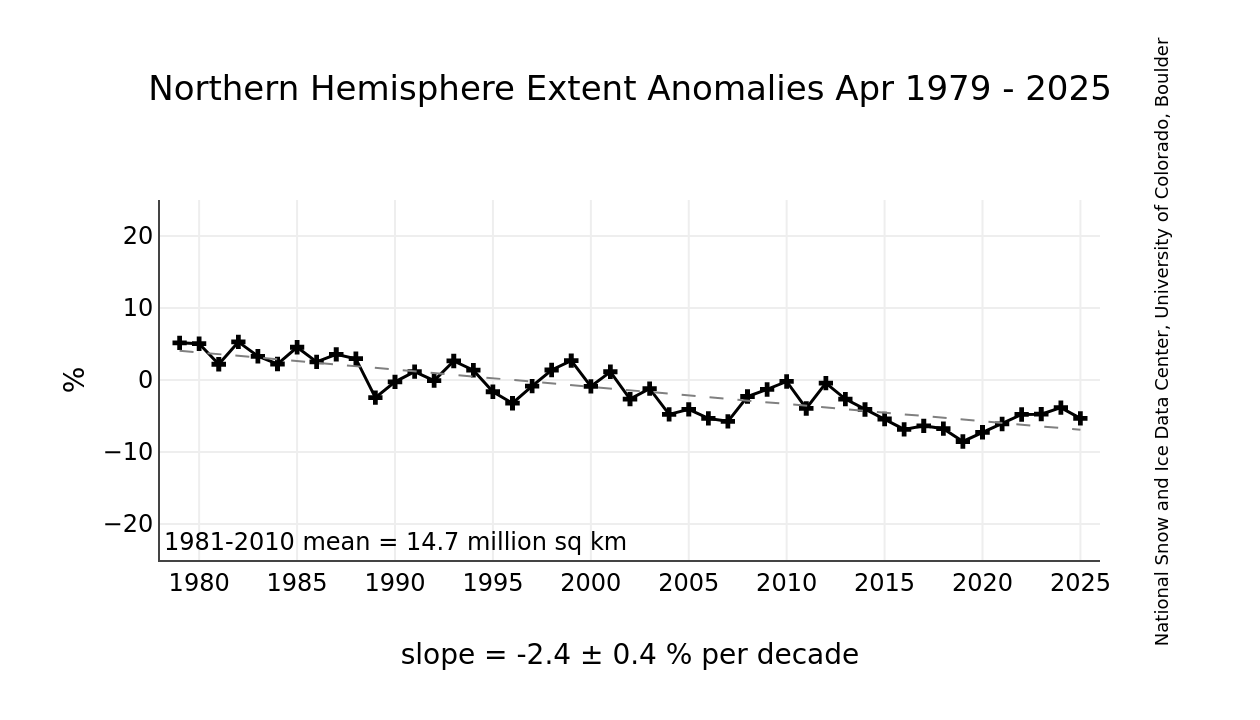
Umm. No. The thickness and coverage of the arctic ice has decreased dramatically over time, even during its annual maximum extent. Yes, it melts and refreezes, but each time it refreezes, there's less and less, with a linear trend of -8.7% per decade. http://nsidc.org/data/seaice_index/images/n_plot_hires.png


9) Polar bear populations are now four times greater than 50 years ago, even though they are declared an endangered species.

http://www.polarbearsinternational.org/ask-the-experts/population/
Polar bear populations rebounded after restrictions on hunting. This has nothing to do with global warming. The loss of their habitat does.

10) Melting floating sea ice causes sea level to decrease, not increase. Try this: Fill a glass with ice then add water to the rim. When the ice melts, the water level in the glass drops!

Try this: Freeze pure water. Put those ice cubes in a glass of salt water. Measure the level of the water. Let the pure ice melt. The level of the water will be higher. Salt does not stay in sea water as it freezes.
http://www.physorg.com/news5619.html

Next, try this: Put a bowl of salt water in your sink, measure the height of the water. Put ice cubes on a dish rack drainer so that it drains into the bowl of water. Let the ice cubes melt. Watch the water level in the bowl increase. This is what is happening when glaciers and antarctic ice melts. They're on land, not in the sea.

11) If the water level were rising, the angular velocity of the earth would decrease, like a spinning skater who extends her arms. This velocity can be measured precisely and is not changing!

The angular velocity of the Earth HAS decreased: http://www.sciencemag.org/cgi/content/abstract/215/4530/287, and the observed melting ice accounts for about 3/4 of the reduction in the angular velocity since 1940.

12) Al Gore tells us that arctic ice cores show that heating occurs after CO² increases. In fact the opposite is true. Ice cores clearly show that temperature decreases are followed by CO² increases and this has happened for hundreds of thousands of years, even without SUVs and
smoke stacks.


This is untrue.
http://maps.grida.no/go/graphic/historical-trends-in-carbon-dioxide-concentrations-and-temperature-on-a-geological-and-recent-time-scale


13) Historically, whenever we have a sunspot low we also have a lower temperature. The Little Ice Age in 1600 coincides with a 60 year sunspot low called the Maunder Minimum.

Almost true. The Maunder Minimum was 70 years long (1645 to 1715), the Little Ice Age (which was not a true glacial period, just cold) may have begun in 1250, when the Atlantic ice pack began to regrow, or it may have started as late as 1650 when the local climatic minimum began. So, we had 70 years of low sunspot activity out of a 400-year uncertainty about the BEGINNING, much less about the length of a cold period. The "Little Ice Age" lasted until about 1820.

14) The cooling scare in the 1970s, reported by the media as the Coming ice age,” came during a sunspot dip.

There was no cooling scare. There was a single paper about a possibility of cooling, the media (and recent head-in-the-sand deniers) took up the rest. The greenhouse gas problem has been known since at least 1859.
http://www.aip.org/history/climate/timeline.htm

Sunspot activity is on an ~11 year cycle. We do not see a 11 year cycle in the warming and cooling of the Earth. We see an exponential trend toward higher temperatures. We're in the middle of another solar minimum right now, during which we've experienced the highest globally averaged temperatures on historical record.

15) Sunspots set up an ionized layer around the planet which blocks
incoming cosmic radiation.


Umm... Not really. Increased sunspot activity is also often accompanied by increases in outflow of matter from the sun (an increase in the solar wind). Charged particles in the solar wind
affect the upper atmosphere (the ionosphere) and mess up communications. Sometimes, the atmosphere is warmed by these interactions and becomes slightly larger, which also affects communications satellites.

16) Cosmic rays cause cloud formation which in turn cools the earth. So, few sunspots — cooler earth. More sunspots — warmer earth.

There is no correlation between cosmic ray activity and cloud formation. There is no evidence that cosmic ray activity has decreased over the last few decades.
http://www.agu.org/pubs/crossref/2002/2001JD000560.shtml
http://www.sciencedaily.com/releases/2008/12/081217075138.htm

17) We are in an historic sunspot low. That’s why winters are colder
and longer.


Winters are NOT longer, nor are they colder. http://data.giss.nasa.gov/gistemp/graphs/
Go to the Seasonal Mean Temperature Change most of the way down the page.
http://data.giss.nasa.gov/gistemp/graphs/Fig.E.lrg.gif
The same trend seen in global average temperatures is seen in winter temperatures. Temperatures are increasing.


18) If sunspot cycle 24 does not start soon in earnest, blow more insulation in your attics! It is also clear that in periods of high sunspot activity, the climate is warmer.

Except the trend for higher temperatures matches a trend for LOWER sunspot activity.
http://en.wikipedia.org/wiki/File:Temp-sunspot-co2.svg


I find it interesting that they started this with denying that there is any warming. Then they moved to arguing that CO2 can't be the cause for the warming we see, then they started arguing that the warming we do see is natural, then they began making up stuff. And they end with conspiracy theories.

Anthropogenic climate change is real. It's happening now, and if we don't stop it, it's going to cause some serious problems for our children and their children.

The rest is just scare tactics. "They're going to eat your babies and
euthanize your grandmother. And also take away your Lincoln
Navigator."

One more thing, though. Stopping the emission of greenhouse gases is actually pretty darn cheap. Especially if you consider the easiest thing to do is not use as much energy.

http://www.epa.gov/climatechange/economics/economicanalyses.html
http://www.sciencemag.org/cgi/content/short/316/5828/1181
http://www.nytimes.com/2009/09/25/opinion/25krugman.html?_r=2
http://krugman.blogs.nytimes.com/2009/09/27/the-textbook-economics-of-cap-and-trade/
http://blogs.edf.org/innovation/2009/09/24/giving-a-green-light-to-greenhouse-gas-savings/
http://wonkroom.thinkprogress.org/2009/09/18/cbo-debunks-beck/
http://www.jstor.org/stable/1243120
http://www.atypon-link.com/AEAP/doi/abs/10.1257/aer.98.2.1 (PDF)
http://cboblog.cbo.gov/?p=361
http://www.nytimes.com/2009/09/28/opinion/28krugman.html?_r=1
http://wonkroom.thinkprogress.org/2009/09/17/cbs-twitternomics-flat-wrong/


Global warming: Analyze the facts
By GUNNAR C. CARLSON JR.
Colonel, U.S. Army, Retired
With all the debate about Global Warming and Cap and Trade, I think a close examination of the facts is appropriate and badly needed.
The average temperature of our earth has been unchanged for the last 10 years, and in fact is now trending downward. CO² is only 3.6 percent of the total greenhouse gasses, when water vapor, the largest greenhouse gas is included. Only ..117 percent of this CO² is manmade. This small amount of CO² makes little difference in our global temperature. In fact the earth has only warmed 1/10th of a degree due to CO² since the industrial revolution, and has=2 0warmed only one (1) degree in the last 150 years from all causes.
The primary reason that CO² is ineffective in warming our earth is because the CO² absorption band in the atmosphere is almost saturated, so adding more CO² has little effect. CO² is not a harmful gas to humans, even though it has been declared a pollutant. It is a vital fertilizer to plant life. To be harmful to humans the concentration would need to be 6,000 parts per million. We are at 380 PPM at present. The average CO² concentration in submarines is 4,000 PPM and this does not make the submariners sick.
Remember that greenhouse gasses act by absorbing heat, then reradiating it back to earth. The greenhouse alarmists have developed a computer model that predicts, due to the action of gasses, there will be a “hot spot” in the atmosphere at a height of 12 kilometers. Actual balloon measurements show no such “hot spot.” This and other alarmist models have proven to be wrong and erratic. If we can’t predict next week’s weather, how=2 0can we predict the climate years in the future?
Polar ice melts and refreezes on a regular cycle with the low point occurring in September in the Northern Hemisphere and March in the Southern Hemisphere. All the melting reported by alarmists in the Northern Hemisphere in September will be restored in March, year after year! Polar bear populations are now four times greater than 50 years ago, even though they are declared an endangered species.
Melting floating sea ice causes sea level to decrease, not increase. Try this: Fill a glass with ice then add water to the rim. When the ice melts, the water level in the glass drops! If the water level were rising, the angular velocity of the earth would decrease, like a spinning skater who extends her arms. This velocity can be measured precisely and is not changing!
Al Gore tells us that arctic ice cores show that heating occurs after CO² increases. In fact the opposite is true. Ice cores clearly show that temperature decreases are followed by CO² increases and this has happened for hundreds of thousands of years, even without SUVs and smoke stacks.
Historically, whenever we have a sunspot low we also have a lower temperature. The Little Ice Age in 1600 coincides with a 60 year sunspot low called the Maunder Minimum. The cooling scare in the 1970s, reported by the media as the “Coming ice age,” came during a sunspot dip. But why?
Sunspots set up an ionized layer around the planet which blocks incoming cosmic radiation. Cosmic rays cause cloud formation which in turn cools the earth. So, few sunspots — cooler earth. More sunspots — warmer earth. We are in an historic sunspot low. That’s why winters are colder and longer. If sunspot cycle 24 does not start soon in earnest, blow more insulation in your attics! It is also clear that in periods of high sunspot activity, the climate is warmer.
31,000 physical scientists have signed a petition denying any manmade effects on our climate. These are people having no government grants or tenure, so they won’t lose their jobs.
Why would anyone want to convince us that we are causing climate change? This is so they can control:
— What you can eat
— What you can smoke
— What kind of car you can drive
— How much you can drive
— The temperature of your home
— What we can manufacture
— Your power sources
— How many cows you can own
— What light bulb you can use
— What appliances you can use
— Your hot water use
— Your air travel
— Your type of house
— Carbon tax
— Carbon credits
All these things amount to billions of dollars in profit. Follow the money!
$79 billion, and billions of hours of labor and effort have been squandered so far in the USA. The Carbon Market cost will be $2-$10 trillion in the near future if “Cap and Trade” becomes law.
This money and=2 0effort could be used for:
— Reducing real pollutants
— Fighting poverty
— Treating aids and malaria
— Providing adequate drinking water and medical treatment
Public policy which attempts to correct this nonexistent problem could literally cause millions of people to di e.
Considering all of the above, it is clear that climate is changed by nature and not man.